



Split-Phase Home Solar Monitoring for North American 120/240V Systems
Why Split-phase Solar Monitoring Is Different
Most homes in the United States and Canada use a 120/240V split-phase electrical system. This creates a different monitoring requirement from a simple single-phase system.
For a North American home solar PV system, the homeowner often needs to understand:
- Power on both grid legs, L1 and L2
- Grid import and grid export
- Solar inverter output
- Home consumption
- Solar self-consumption
- Net metering or feed-in behavior
An inverter app may show solar production, but it usually does not show the full relationship between the grid, the home, and the PV system.
IAMMETER meters can be used to monitor these values and send the data to IAMMETER-Cloud, Home Assistant, or a local system.
For the broader global home solar topic, see:
Understanding 120/240V and 120/208V Systems
In a typical North American 120/240V split-phase home, two hot wires are supplied:
- L1 to neutral: about 120V
- L2 to neutral: about 120V
- L1 to L2: about 240V
Large loads such as dryers, HVAC equipment, water heaters, and EV chargers may use 240V. Normal outlets and lighting circuits usually use 120V.
Some apartment or light commercial sites may use a 120/208V system. The monitoring principle is similar, but the electrical system should be confirmed before installation.
What a Complete Solar Monitoring Setup Should Show
For a split-phase home solar system, the ideal monitoring result includes:
- Real-time solar production
- Real-time home consumption
- Grid import from both legs
- Grid export to the utility
- Daily and monthly imported energy
- Daily and monthly exported energy
- Self-consumption rate
- Electricity bill, feed-in income, and savings
This helps users answer the practical question: is the solar system actually reducing the bill?
Related report page:
Practical IAMMETER Wiring Options
For North American split-phase systems, IAMMETER provides several options depending on the monitoring goal.
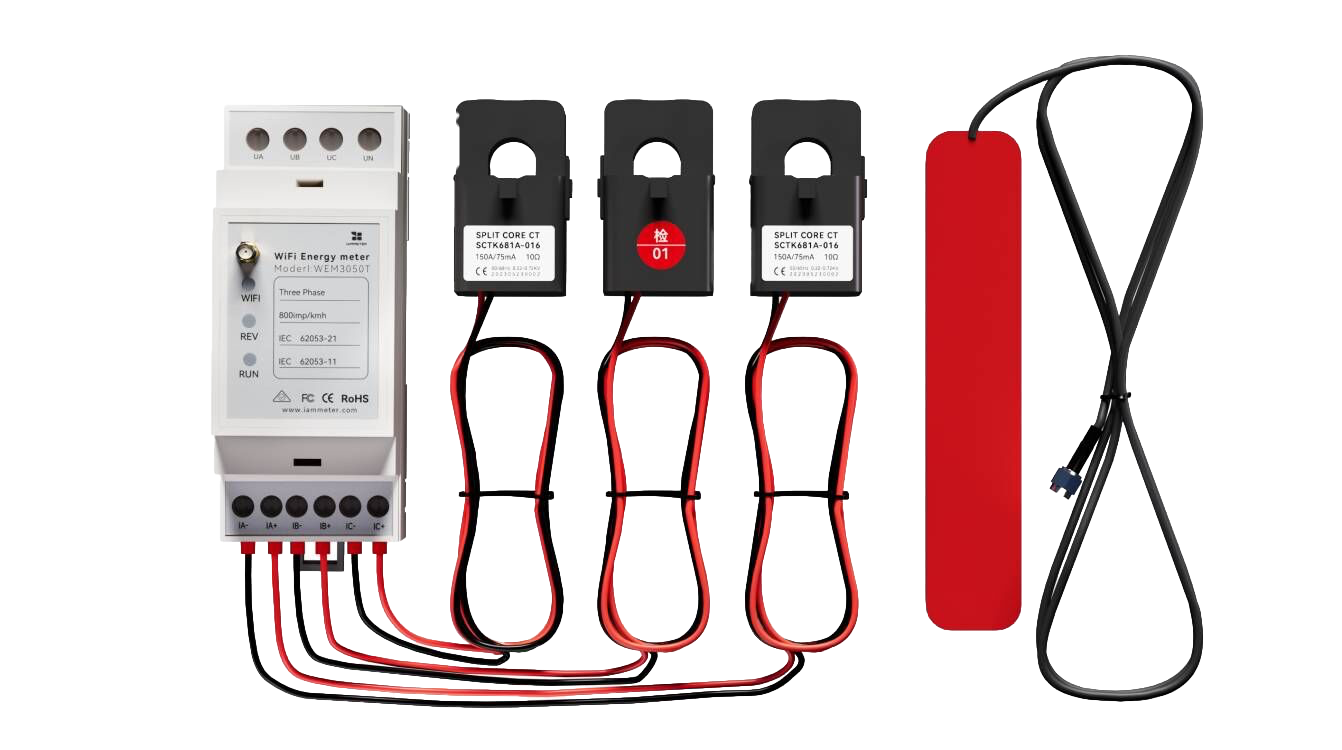
Option 1: WEM3050T for Split-phase Solar Monitoring
WEM3050T provides three measurement channels.
In a common split-phase solar setup:
- Phase A monitors grid leg L1
- Phase B monitors grid leg L2
- Phase C monitors one leg of the solar inverter output
If the inverter output is balanced across L1 and L2, the Phase C value can be doubled by configuration to represent total inverter output.
This is a cost-effective way to monitor grid import/export and solar production in one split-phase solar setup.
Option 2: WEM2067 for Split-phase Grid Monitoring
WEM2067 has two measurement channels.
It is suitable for:
- split-phase grid-side monitoring
- simple dual-channel monitoring
- single-phase solar systems where one channel measures grid and one channel measures inverter output
Important limitation: if both WEM2067 channels are used for split-phase grid monitoring, there is no extra channel left for inverter output monitoring. For split-phase grid plus inverter monitoring in one device, WEM3050T is usually a better fit.
Option 3: Professional Three-phase Meters
For professional projects or higher-current requirements, users can also consider:
Home Assistant and Local Data
Many North American solar users want local dashboards and automations.
IAMMETER supports Home Assistant and local integration methods such as:
- Local API
- MQTT
- Modbus/TCP
- Node-RED
This allows users to build dashboards for:
- grid import/export
- solar production
- home consumption
- net metering behavior
- solar surplus automation
Related page:
From Monitoring to Solar Surplus Usage
Monitoring is the first step. Once users know when surplus solar energy is exported, they can decide how to use more of it inside the home.
For example, suitable resistive loads such as water heaters can be controlled with:
This is especially useful when exported solar energy has a lower value than imported electricity.
Related North America Split-phase Resources
- WEM3050T Split-phase Monitoring in North America
- Split-phase Solar Monitoring with WEM3050T
- WEM3050T Wi-Fi Energy Meter
- WEM2067 Dual-channel Wi-Fi Energy Meter
- Home Solar Wiring Diagram
Summary
North American split-phase solar monitoring needs more than a simple solar production chart.
A useful monitoring system should show:
- both grid legs
- grid import/export
- solar production
- home consumption
- self-consumption
- bill and savings impact
IAMMETER provides flexible meter options for this use case, especially WEM3050T for split-phase grid plus solar monitoring and WEM2067 for simpler dual-channel scenarios.